Share
ReviewPoetry · 3 min read
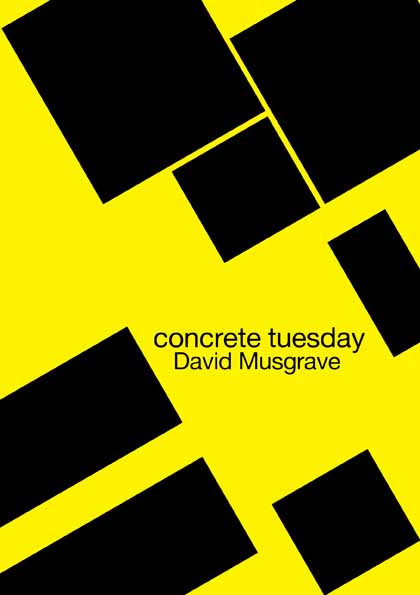
Concrete Tuesday
Driving in reverse the only way forward on roads that are less than concrete
Fiona Wright reviews David Musgrave's Concrete Tuesday in The Australian February 18 2012
(excerpt)
David Musgrave caused something of a stir recently when he published a six-word poem in The New Yorker titled On The Inevitable Decline Into Mediocrity of the Popular Musician Who Attains a Comfortable Middle Age. It's a wonderful title, witty, mock-pompous and playful with expectations, with language and its possibilities. And these are characteristics of Musgrave's work that make his new collection, Concrete Tuesday, so enjoyable. Some of the most effective short poems in this volume are those that show Musgrave's linguistic playfulness to its full advantage. At times, this manifests as a formal brashness and risk: in poems such as Nostalgia Addict, a sestina structured around challenging end-words including cradle, needle, reverses and cupboard. Elsewhere, Musgrave takes a more simple delight in odd juxtapositions and collections of found words. This is especially funny in The Water in Japan, which quotes slogans from “a river of T-shirts” seen on a train, phrases such as “… see porridge?” These odd and strangely mangled snatches of found language are brought into some kind of poignancy and resonance within the poem.
But Musgrave's humour is more often sharply satirical, and especially biting when focused on poetry itself, as well as its place within Australia. The largest sequence in the book, 'The Poet's House', is an imagined account of a guided tour through the home of a great – and fictional – Australian poet, complete with biographical snippets (“That's where/ his third wife died when the set of shelves collapsed”) and an on-site lunch break. The sequence begins with a quote from Pablo Neruda, a clear model for the poem's fictional writer, who also became a diplomat in later life, and whose home is now memorialised for tourists. While the poem is at times a little obvious, with jokes about constipation and creativity, it is an energetic play on the ideas of literary fame and literary tourism, as well as their impossibility in Australia.
But this sequence also illustrates another interest element to many of the poems in this collection: an awareness and manipulation of length, and slower rhythms. Musgrave's sentences are often long, and slip over the boundaries of individual poems (as in this sequence), stanzas, or the title and text itself. Many poems, such as 'The River' and 'Ancestral Home's are built from one extended sentence; others draw out one thought or a single image along the length of the poem. It brings some sense of recursion, or spiralling to the poems, of a single point that is looped back to and around, even as the poem progresses….
Fiona Wright
Read this review in The Australian
This review first appeared in The Australian. Read the full review ↗
More reviews
Review · Anthologies
Raging Grace: Australian Writers Speak Out On Disability
“… the incisive, creative critiques of the medical model and its legacy … the radical rejection of subject/object…”
Reviewed by Erin Scudder
Sydney Review of Books · 7 Apr 2025
Review · Poetry
She Doesn’t Seem Autistic & Sanctuaries
“There is something about [She Doesn't Seem Autistic]! It’s like nothing I have ever come across before.”
Reviewed by Jennifer Compton
Cordite · 25 Mar 2025