Share
ReviewPoetry · 3 min read
The Welfare of My Enemy
Australian poets giving voice to others
Bonnie Cassidy reviews The Welfare of My Enemy Jun 2, 2012
(excerpt)
In his 12th book of poems, The Welfare of My Enemy, Newcastle-based Anthony Lawrence joins an Australian tradition of crime verse that includes Alan Wearne and Dorothy Porter. It's potent territory, where wittily ruthless cons and crims speak in iambs worthy of Iago. Such characters are self-aware constructions, calculating and cynical; and know their jobs as well as their own pathologies, as Lawrence reveals:
I've heard them calling for mother and Christ.
One thought he was a f . . king resurrectionist
Said, “come on then, do it, I'm ready, and I'll return
and you'll be sorry.” These people never learn.
I did what he wanted. He kneeled. I put him down.
That was what? Ten years ago? Clown.
Traditionally, this voice is counterpointed by that of the detective – hard-boiled, usually, or a raconteur. Lawrence follows suit, focusing on the phenomenon of missing persons. Rather than a narrative, however, it's a sequence of self-contained vignettes and monologues that lurk, hide or peer from the margins of its theme.
Lawrence creates a hellish landscape of highways, suburbs and towns, and a lasting effect of time passing by waiting parents, imprisoned killers, unquiet ghosts and willing wanderers. In the wrong hands, this subject matter might be treated gauchely; but, while Lawrence's language sometimes desires the economy of Porter, his authority figures – detective, policeman, warden – read more like stylisations of actual records than fictional constructions. He goes for voice rather than character, particularly the voice of the mind in “fugue”: neither good nor bad but utterly lost in the fog of grief or psychosis.
In place of narrative structure, Lawrence adopts rhyming couplets and rough pentameter. At times, this form forces notes of pathos and insight into prosaic phrasing: “We found ourselves in a difficult position in bed / in a back room of the aforementioned shed”. Similarly, the romantic tendencies of Lawrence's previous poetry can be glimpsed in occasionally hackneyed word choices (“false trails and fading hope”) and hyperbole (“the hemorrhaging of the heart- / blood of a young couple's lives”). By the same token, the poet's established flair for natural imagery is stunningly used:
There were wide, dispersing rings
on the river, as if someone had dropped a stone
or a fish had risen. I rowed back to the car then
thinking about how a boy's voice might sound
in the bush, under pressure. But then my phone
went off, and I drifted as I spoke, watching the dragon-
flies sample dark water.
Like days and years, Lawrence's poems circle around images of rotting leaves, native animals, flashing headlights and caves.
Ultimately, such concrete things betray the language of the missing. In the book's prologue and coda poems – disclaimers, perhaps, or apologies – the poet reveals his own voice to speak about the incapability of language to hide or express the “fear inside my words”. An open-ended sequence, The Welfare of My Enemy uses both form and formlessness to convey the illusions of linkage and closure surrounding disappearance.
Read the review in The Australian (access requires subscription)
This review first appeared in The Australian. Read the full review ↗

More reviews
Review · Anthologies
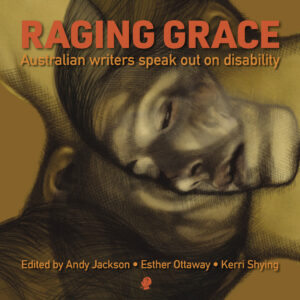
Raging Grace: Australian Writers Speak Out On Disability
“… the incisive, creative critiques of the medical model and its legacy … the radical rejection of subject/object…”
Reviewed by Erin Scudder
Sydney Review of Books · 7 Apr 2025
Review · Poetry
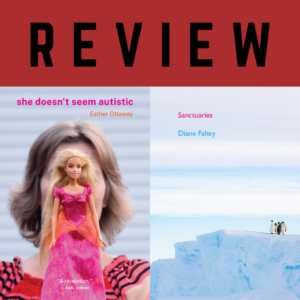
She Doesn’t Seem Autistic & Sanctuaries
“There is something about [She Doesn't Seem Autistic]! It’s like nothing I have ever come across before.”
Reviewed by Jennifer Compton
Cordite · 25 Mar 2025