Share
ReviewPoetry · 4 min read
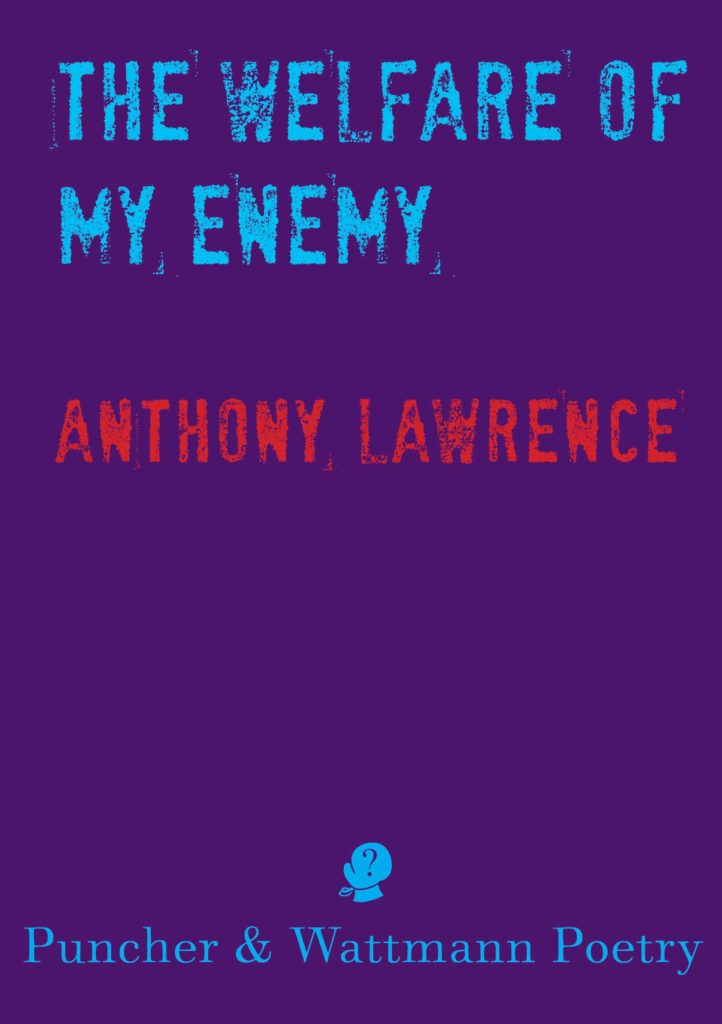
The Welfare of My Enemy
Another Year, Another Engrossing Crop
Martin Langford reviews Anthony Lawrence’s The Welfare of My Enemy in Meanjin 2 2013
(excerpt)
Anthony Lawrence’s The Welfare of My Enemy is a collection of poems about the missing, and the anxieties that attend them. In poems of various lengths, written in buoyant free-verse couplets, he ranges through every situation and point of view that missing conjures—some trivial or temporary, but others, like the anxieties, unable to avoid the possibility that the nightmares might be real.
The idea of the missing is a recurring one in the contemporary world. For people who are personally affected, it is natural that they should be haunted by those who aren’t present. But it also has a broader resonance. We seek security from our narratives. Our birth certificates and driver’s licences are artefacts that we place great faith in: sound evidence in a diegetic world upon which the more contested aspects of our stories—our CVs and moral personae, our claims to spiritual worth—are erected. But what if the body around which everything coheres—certificates and licences included—disappears without explanation? The loose thread can be as disturbing as the missing flesh. We live in economies of narratives where to survive we must commit both to our stories and to the way they interweave with everyone else’s. The idea that a narrative can simply be excised challenges our investment in our own. We have a stake in the sustainability of all stories—other people’s as well as our own.
Lawrence explores the whole range of reasons to go missing: gambling debts; the oppression of responsibility or marriage. Some of his speakers have grown tired of interaction and gone bush. There is one compelling group of poems about people who go missing from their own heads. The largest number, however, are about those who get into the wrong car, or who are watched by objectifying eyes on their way to the shops, and over time, the poems gravitate towards situations where missing does turn into nightmare, and the sequence ends dominated by the presence of Ivan Milat. There is no resolution to the exploration of an idea: the possibility simply persists. For all the drift towards nightmare, however, Lawrence is rarely interested in the details of how someone died: the book leaves us with a sense of the uneasy tension between the actualities of nightmare and the more self-interested anxieties of the public—which is probably a fair summary of the situation that pertains.
Interestingly, he doesn’t greatly alter the speaking voices as he moves from one character or situation to another. No matter who they are—even if they are criminals—they all have something of the empathy of the poet and something of the shrewdness of the detective. As a result, they all become versions of the one voice: incidentals of time and place remain just that. The victims are also versions of each other; and everyone, we know, is a potential victim. So this is not a book about any particular identity going missing. If Lawrence’s attitudes are representative of the way our understanding of missing is now inflected, then one might say that last century’s anxiety about the specific nature of one’s identity—as exemplified, say, by the tensions between Ellen Roxburgh and Ellen Gluyas in Patrick White’s A Fringe of Leaves, Eddie and Eadith in his The Twyborn Affair, or Will and Toki in R.D. Fitzgerald’s collection Between Two Tides (1952)—has morphed into a broader concern about the fragility of all identity, irrespective of where it has come from.
Read the full article on the Meanjin website
This review first appeared in Meanjin. Read the full review ↗
More reviews
Review · Anthologies
Raging Grace: Australian Writers Speak Out On Disability
“… the incisive, creative critiques of the medical model and its legacy … the radical rejection of subject/object…”
Reviewed by Erin Scudder
Sydney Review of Books · 7 Apr 2025
Review · Poetry
She Doesn’t Seem Autistic & Sanctuaries
“There is something about [She Doesn't Seem Autistic]! It’s like nothing I have ever come across before.”
Reviewed by Jennifer Compton
Cordite · 25 Mar 2025